

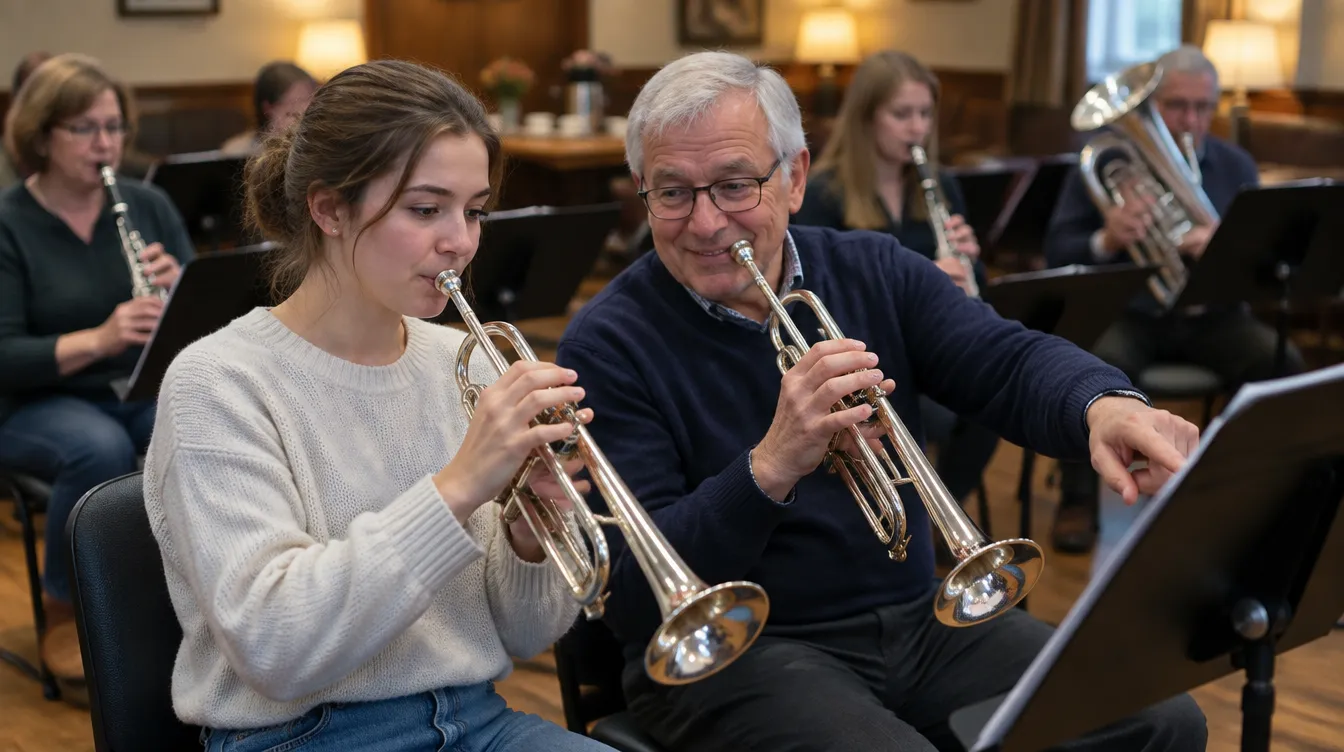
The second trumpets are well past retirement age, the tuba player sits alone, and the choir's tenors can be counted on one hand. Many bands and choirs will recognize this: the membership is getting older, and too few new musicians are joining. In this article you'll read why recruiting matters so much right now, which recruiting methods work and which don't, and why good organization may well be your best recruiting tool.
Why recruiting matters more than ever
"Recruiting new members is the biggest challenge leisure-time music groups face," says Making Music, the UK organization for amateur music groups. Many bands, choirs and orchestras see their average age go up year after year, while fewer young people join by default.
There's good news too. Making Music highlights project-based recruitment, where new singers or players join for one concert or program first, as a model that delivers impressive results. In short, it can be done, but it doesn't happen by itself.
It used to be common for children to join the band their parents played in. Those days are gone. New members now mainly come when they see a good reason themselves, which means the group has to offer something that fits their lives.
First: know who you're looking for
"More members" isn't a goal you can work with. Start by looking at your current membership:
- Which parts are missing? No horn, only one percussionist, too few altos or tenors? Then you know exactly what to look for.
- What's the age mix per section? A section where everyone is over sixty will have a problem in a few years.
- How many members join, and how many leave? If more members leave each season than join, start with keeping members as well. Recruiting and retention go hand in hand: happy members are your best ambassadors.
Then choose your target groups. The four most important ones for a band or choir:
- Young people and students from a music school, your own training program or a school project.
- Young adults: students and early-career professionals, often with experience from their youth, but with an unpredictable schedule.
- Returners: people who played or sang when they were younger and have time again after a busy period. A large and often overlooked group.
- Newcomers to your town, who are looking for a place to make music and meet people.
Four common ways to recruit
Most groups recruit in one or more of these four ways.
1 Flyers and posters
A flyer through the door, a poster in the supermarket or at the music school, or a piece in the local paper.
How to do it well:
- Be specific: which instrument or voice part you're looking for, when you rehearse and what people can come and do.
- Put one clear next step on the flyer, such as "come and play along on November 14, no commitment."
- Put them where your target group goes: the music school, the library, the community center or one of your own concerts.
Where it falls short: a flyer gets lost among the other mail. Without a concrete next step, hardly anyone shows up.
2 An open rehearsal or come-and-play day
Anyone who's interested can sit in on a rehearsal or play along for a day, with or without their own instrument.
How to do it well:
- Pick pieces people can join without preparation.
- Have a member in every section ready to welcome visitors and explain what's going on.
- Provide coffee and time to chat afterwards.
Where it falls short: it takes a lot of preparation, and without good follow-up you'll never see visitors again.
3 Social media
A Facebook page, an Instagram account or short videos of a performance or rehearsal.
How to do it well:
- Show the atmosphere: a rehearsal up close, a joke during the break, the competition day.
- Let members say in their own words why they enjoy it.
- Post regularly, not only when there's a concert.
Where it falls short: keeping an account going takes ongoing time, and it often comes down to one enthusiastic member. When they stop, the account goes quiet.
4 Word of mouth: your members as ambassadors
Members bring a friend, colleague, neighbor or grandchild to a rehearsal.
How to do it well:
- Ask personally and specifically: "Who's bringing one person to the open rehearsal?"
- Give members something to share: an invitation they can forward, or a video of a performance.
- Thank members who bring someone along, even if that person doesn't join.
Where it falls short: it only works if members are enthusiastic themselves. And your reach stays limited to your current members' circles, which often look alike.
| Reach | Effort | Works best for | |
|---|---|---|---|
| Flyers and posters | Wide, but low response | Medium | Getting known locally |
| Open rehearsal | Small, but personal | High | People who are already considering it |
| Social media | Wide and good for younger people | Ongoing | Showing the atmosphere |
| Word of mouth | Small, but high trust | Low | Returners and friends of members |
You get the best results by combining them: social media and flyers spark curiosity, your members invite people personally, and the open rehearsal is the moment someone takes the step.
What younger musicians look for in a group
Younger musicians are often busy with study, work, moving and other hobbies. They choose carefully how they spend their evenings. A few things make the difference:
- Clarity upfront. How often do you rehearse, what's expected, what does membership cost and can they borrow an instrument or uniform? If they have to chase that information, they drop out sooner.
- Try first, then decide. Not signing up for years straight away, but first playing along for one project or a few rehearsals. That's exactly why project members are on the rise.
- People their own age. Nobody wants to be the only one under thirty. So try to recruit a few younger people at once rather than one by one, for example through a group of friends or a music school class.
- Friendship and connection. For many members, that's the main reason to stay.
- A group that's well run. People who grew up with a smartphone are used to schedules showing up in their calendar and sending apologies being one message. A group with five chat groups, a paper schedule and parts that are handed out at rehearsal feels old-fashioned, however good the music is.
That last point is often underestimated. How a group is organized and how it communicates with its members is part of its image. A new musician doesn't judge your group only on the first rehearsal, but on everything around it.
Checklist: get your organization in order before you recruit
Before you invite new members, check that the basics are in place. A new member who gets lost in the first few weeks won't come back.
- One fixed channel for news and apologies that everyone knows.
- The season schedule is known: rehearsals, concerts and competitions, ideally in members' own calendars too.
- Sheet music and parts are ready for a new musician, on paper or digitally.
- A go-to person for every new member, for example someone from the same section.
- A welcome message with everything a new member needs to know: where, when, what it costs, who the conductor is and who to ask.
- Instrument and uniform loans are arranged, or at least you know who handles them.
- Your website and social media are up to date, with rehearsal time, location and a contact person.
- A trial period is agreed: how many rehearsals can someone join without commitment?
Step by step: how to organize an open rehearsal
For many groups, an open rehearsal is the moment recruiting becomes real. Here's how to go about it:
- Set the date six to eight weeks ahead, ideally at the start of the season or a new project, so new musicians can join right away.
- Pick pieces people can play along with. Not your hardest competition piece, but something recognizable that a beginner or a slightly rusty musician can join in on.
- Have parts ready for every section, with a few spare copies.
- Ask members to invite people personally. Ask every member to bring one person, and back it up with a social media post and a note in the local paper.
- Organize the welcome. Someone at the door, a go-to person per section, and a chair that's already set up.
- Keep the rehearsal short and varied. Let visitors play along, but also let them hear how the band or choir sounds as a whole.
- Take time for coffee afterwards. Explain what the group does, when you rehearse and how the trial period works. Ask whether you can get in touch later.
- Follow up within a week. Send a personal message and invite visitors to the next rehearsal or upcoming project. This is where it most often goes wrong.
From guest to member
Recruiting doesn't stop at the first rehearsal. The first few weeks decide whether a new musician stays. Make sure a new member knows from day one when rehearsals are, has their part and has a go-to person in the section. After a few weeks, ask how it's going, and at the end of the trial period decide together whether they'll join. And if it doesn't click, thank them warmly. People who leave with a good impression tell others.
Recruiting new members with Orchesi
When a new musician comes to try out your group, you want them to know right away where they stand. In Orchesi, you first invite someone as a guest, only for the rehearsals or project they're joining. Guests don't count toward the price, so a trial period or a project member costs you nothing extra. If it's a good fit, you turn the guest into a member, and they immediately see their own calendar, their section's sheet music and the group's news. New musicians can also sign up themselves with your group's invite code, after which the committee approves the request. See how guests work in Orchesi.