


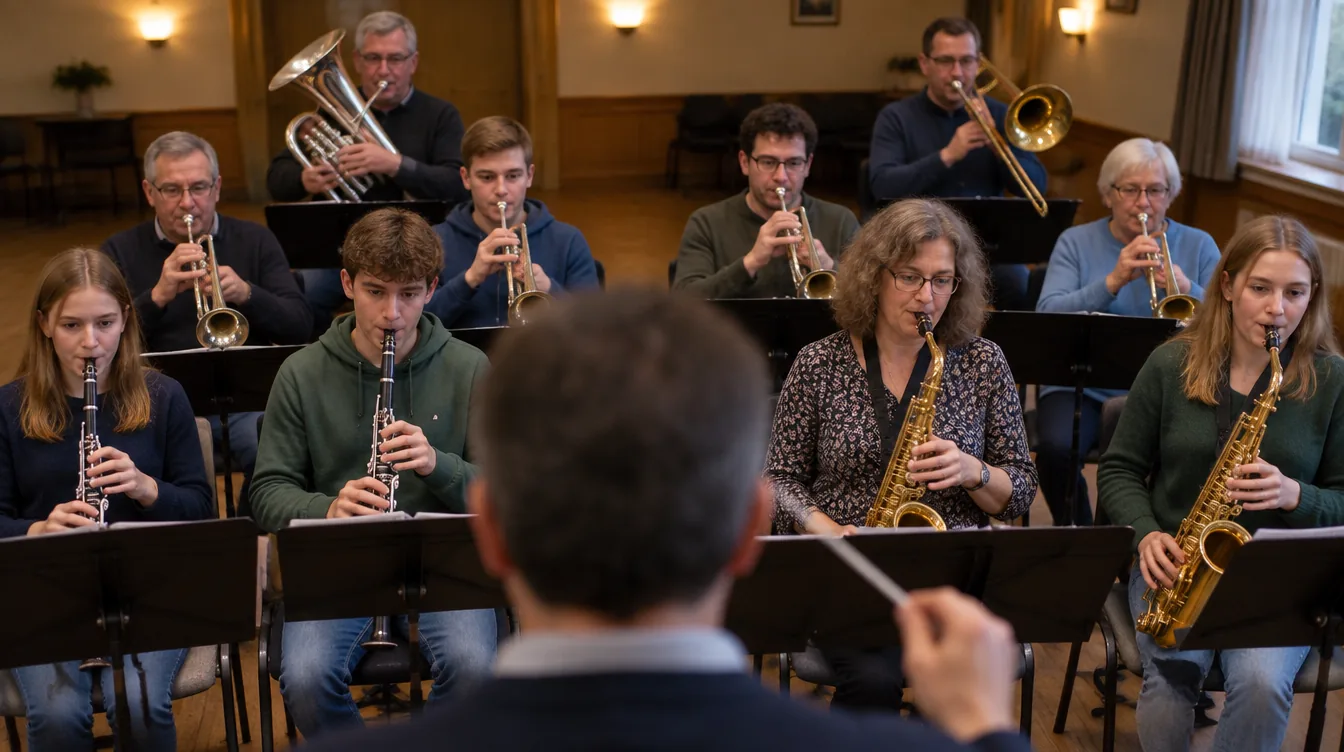
Half a second clarinet section, no tuba, and a conductor who skips the piece as a result: low attendance is frustrating for everyone who does show up. In this article you'll read why members stay away, which common approaches work and which don't, and seven tips to improve attendance in your band, choir or orchestra.
Why members skip rehearsal
To improve attendance, you first need to know why members stay away. The reasons are usually very ordinary:
- A busy schedule. Work, family, school or another hobby. A rehearsal on a fixed evening is the first thing to go.
- The feeling nobody will miss them. In a large ensemble, a member quickly thinks: there are three others on my part, it doesn't matter.
- Rehearsal doesn't feel useful. Waiting a long time while another section practices, or pieces that don't match their level.
- Sending apologies is awkward. If nobody knows who to tell, members would rather quietly stay away.
- It's not fun anymore. This is one of the most common reasons people leave a music group, and falling attendance is often the first sign.
First: know where you stand
You can only improve attendance once you know what it is. Track who comes for a season, and look per section and per period: does it drop after the summer, or around the holidays? How to track it, with a paper list, a spreadsheet, a WhatsApp poll or an app, is covered in How to track rehearsal attendance in your band or choir: 5 ways compared.
Three common approaches
Most groups try to improve attendance in one of these three ways.
1 Talking to members
The chair, the conductor or a section leader talks to members who are often missing.
How to do it well:
- Do it in person and one-on-one, not in the group chat or during rehearsal.
- Ask how they're doing, not why they weren't there.
- Let the section leader have the conversation: they know the member best.
Where it falls short: it takes time and feels uncomfortable for many board members. If it turns into a reprimand, a member drops out even sooner.
2 Discussing the sign-in sheet
The secretary keeps a sign-in sheet and the board discusses the numbers.
How to do it well:
- Discuss numbers per section with the group, and per person only in a one-on-one conversation.
- Look at trends over a few months, not at one missed evening.
- Share what's going well too: a section that's always complete deserves a compliment.
Where it falls short: a list afterward tells you who wasn't there, not why. And a list discussed in the open quickly feels like being monitored.
3 Absence rules in the bylaws
The association writes down how and when to send apologies, and sometimes a minimum attendance for concerts.
How to do it well:
- Keep the rules short: one channel, one deadline, and what applies for a concert or competition.
- Discuss them at the general meeting, so members have approved them themselves.
- Repeat them at the start of every season.
Where it falls short: hardly anyone reads the bylaws. Rules only work if sending apologies is actually easy in practice.
| What it gives you | Risk | Effort for the board | |
|---|---|---|---|
| Talking to members | You hear the real reason | Feels like a reprimand | High: one conversation per member |
| Discussing the sign-in sheet | Insight into trends | Feels like being monitored | Medium: keeping the list |
| Writing down absence rules | Clarity for everyone | Nobody reads them | Low: write them down once |
Seven tips that really improve attendance
- Make sending apologies easy. It sounds contradictory, but the easier it is to say you can't come, the fewer members quietly stay away. And the conductor knows in advance which players will be there.
- Let members see who's coming. Someone who sees that only two horns are coming is more likely to feel missed. That works better than a call to the whole group.
- Share the program in advance. Let people know which pieces are on the schedule. A member who knows their part will be rehearsed is more likely to come.
- Start and end on time. A rehearsal that always runs late is hard to combine with work and family.
- Keep everyone busy. Alternate full ensemble with short sectional moments, so nobody sits waiting for half an hour.
- Remind at a fixed moment. One reminder, only to those who haven't replied yet. People who get messages every day start ignoring them.
- Make it social. Coffee during the break, a drink afterward, and a buddy for new members. Members don't just come for the music, but for each other too.

Sample absence policy
Use this text as a starting point for your own absence policy, for example in a message at the start of the season.
Sending apologies for rehearsals and performances
Can't make it? Let us know through [your agreed channel], no later than 24 hours before a rehearsal and a week before a performance. A short reason (sick, work, vacation) helps the conductor plan, but isn't required. If you'll be away for a longer period, let us know in one go. For concerts and competitions, we expect you at the last two rehearsals. If you miss more often, your section leader will get in touch to see how you're doing.
For more agreements to write down, such as who tracks attendance and what happens to the data, see the checklist for your absence policy.
Improving attendance with Orchesi
In Orchesi, members see beforehand who's coming to rehearsal, and replying takes one tap, with a reason if they want to give one. You set a reply deadline, and anyone who hasn't replied yet gets a reminder automatically. That way the conductor knows in time which players will be there. See how the calendar works in Orchesi.