

Download the instrument inventory with loan agreement (Excel, free)
In many concert bands, brass bands and drum corps, a big part of the group's assets sits in a cupboard or at members' homes. A few trumpets, a sousaphone, the timpani and a set of marching drums quickly add up to tens of thousands. Yet in many groups, only the instrument manager knows exactly what there is and who has it. In this article, you'll read how to organize it better without turning it into a full-time job.
Why good instrument records are worth the effort
- You know what you own. For the budget, the insurance and the question of whether the group can lend a horn to that new junior member.
- Instruments come back. A member who leaves returns the instrument much more easily when it's on record what they took home.
- You avoid arguments about damage. When the condition is written down at handover, it's clear on return what's new.
- Insurance claims go faster. After theft or damage, the insurer asks for the serial number and value. You don't want to dig through old invoices then.
- A new instrument manager can pick it up. The overview isn't just in one person's head.
Step by step: how to organize instrument loans
1 Build an inventory with fixed numbers
Start with a list of everything the group owns. Give each instrument a fixed number, for example T-01 for the first trumpet and S-03 for the third snare drum, and put that number on the case too. For each instrument, record:
- type, make and model;
- serial number;
- year and price of purchase;
- owner: the group, a member, or on loan from someone else;
- condition: good, fair, poor or in repair;
- accessories, such as case, mouthpiece, stand or cover;
- who has the instrument now.
Keep invoices and warranties in one place. A few photos of each instrument help with an insurance claim, and if an instrument goes missing.
2 Put the rules in a loan agreement
Agree beforehand on what you expect from a member, and have them sign. The template includes a loan agreement you can adapt. The key points:
- the instrument stays the group's property and is for rehearsals, lessons and performances;
- the member takes good care of it and reports damage right away;
- repairs always go through the group;
- who pays for damage caused by careless use;
- no lending the instrument to others;
- within how many weeks the instrument must come back when someone leaves;
- how the instrument is insured, including when it's at the member's home.
Already have these rules in your group's bylaws or code of conduct? Refer to them in the agreement, so they don't say different things in two places.
3 Check instruments in and out
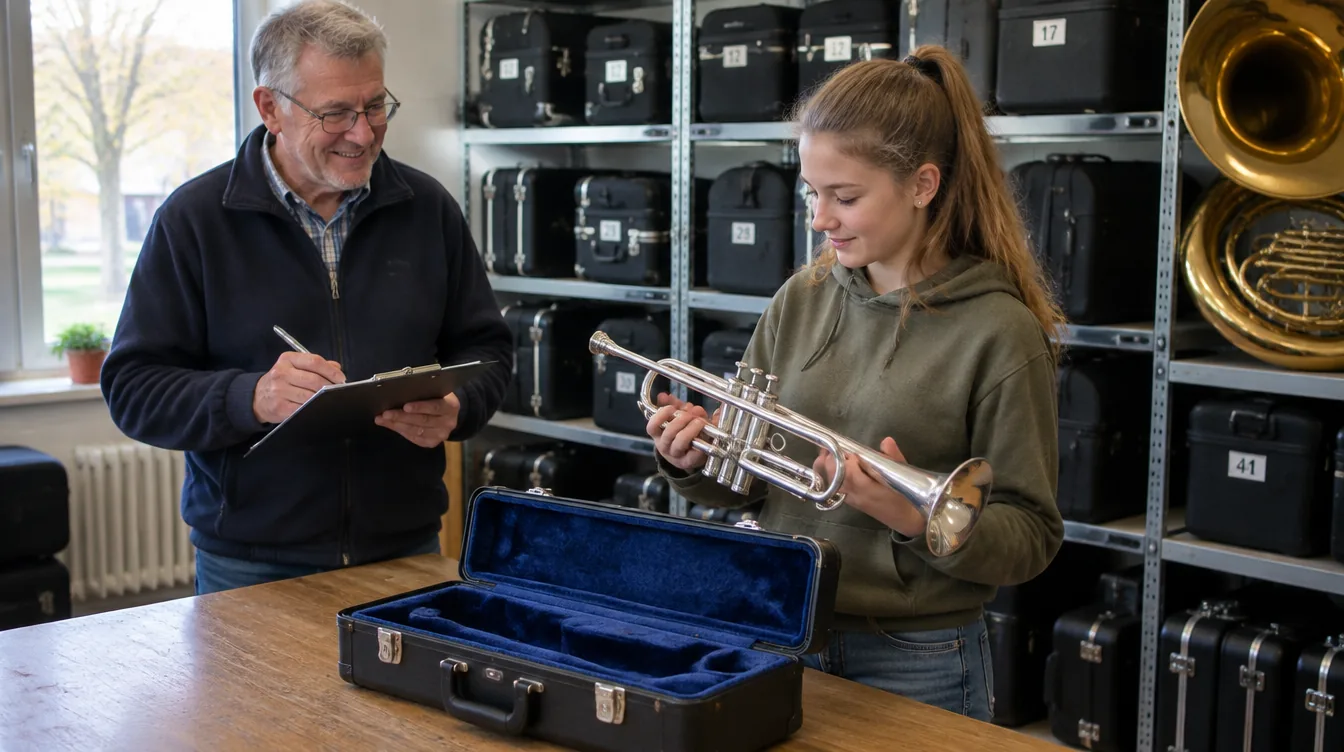
At every handover, go over the instrument with the member. Do the valves or keys work, are there dents, are all the accessories there? Write the condition on the agreement and take a few photos. Do the same when it comes back, so you see right away if anything has changed. Record both in the loan history.
4 Plan maintenance and a yearly check
Have brass and woodwind instruments checked and cleaned regularly, and check percussion for worn heads and loose parts. Record every service and repair, with the cost. Go through the whole inventory once a year, for example before the AGM: is everything still there, is the condition right and is the value still up to date?
Don't forget the insurance
Instruments kept at members' homes, left in a car or taken to a competition run more risk than instruments in a locked cupboard. So check with your insurer:
- whether instruments are also covered at members' homes or in transit;
- which conditions apply, for example to an instrument left in a parked car;
- whether the insured value still matches your inventory.
Some national umbrella organizations for amateur music offer group insurance for instruments and uniforms. It's worth checking with yours.
Three ways to keep track of your instruments
1 A paper loan form and a binder
Every member signs a form, and the instrument manager keeps all the forms in a binder.
How to do it well:
- Use the same form for everyone, with a fixed place for the serial number and condition.
- Give the member a copy, so they know what was agreed too.
- Keep an overview at the front of the binder of which instrument is with whom.
Where it falls short: the overview is in one binder with one person. If the treasurer wants to know what the instruments are worth, someone has to leaf through every form. And a form says nothing about maintenance.
2 A spreadsheet inventory
A spreadsheet with a row per instrument, like our template.
How to do it well:
- Use fixed numbers and dropdowns for the condition, so the list stays tidy.
- Next to the inventory, keep a tab with every loan and return. Years later, you'll still see who had which instrument.
- Keep the file in a shared place the committee can reach, with a backup.
Where it falls short: the file is only as current as the last time someone updated it. Members can't see what they have on loan, and invoices and photos are stored somewhere else.
3 An app for your group
An app where instruments, members and documents are kept together.
How to do it well:
- Enter your whole inventory first, with numbers and serial numbers, before you start lending.
- Attach invoices, warranties and photos directly to the instrument.
- Let members see in the app which instrument they have on loan.
Where it falls short: entering everything takes an evening. And you often still need the signed agreement on paper, or as an attachment.
| Overview per instrument | Loan history | Maintenance | Member sees what they have | |
|---|---|---|---|---|
| Paper and a binder | With difficulty | Only in the forms | No | Only their own copy |
| Spreadsheet inventory | Yes | Yes, if you keep it up | Yes, in a separate tab | No |
| An app for your group | Yes | Yes, automatically | Yes | Yes |
Checklist: lending instruments
- Every instrument has a fixed number, on the case too.
- Serial number, year of purchase and value are in the inventory.
- Invoices and warranties are kept in one place.
- There's one loan agreement, and every member with an instrument has signed it.
- Condition and accessories are recorded at handover, with photos.
- It's clear who arranges repairs and who pays for what.
- You know how instruments are insured at members' homes.
- Returning the instrument is on the list when a member leaves.
- There's a regular instrument manager, with a stand-in.
- The inventory is checked every year.
The same approach works for uniforms, concert clothes and other things the group lends out. Give them their own tab, with size and number.
Managing instruments in Orchesi
In Orchesi, you add every instrument the group owns to the app, with its own code such as TR-01, the serial number, the purchase price, photos and the purchase invoice. You assign an instrument to a member, with notes on its condition at handover, and do the same when it comes back. The full loan history is kept. You track maintenance and repairs per instrument, with the cost and the next service date. Members see in the app which instrument they have on loan, and report damage themselves. See how instruments work in Orchesi.